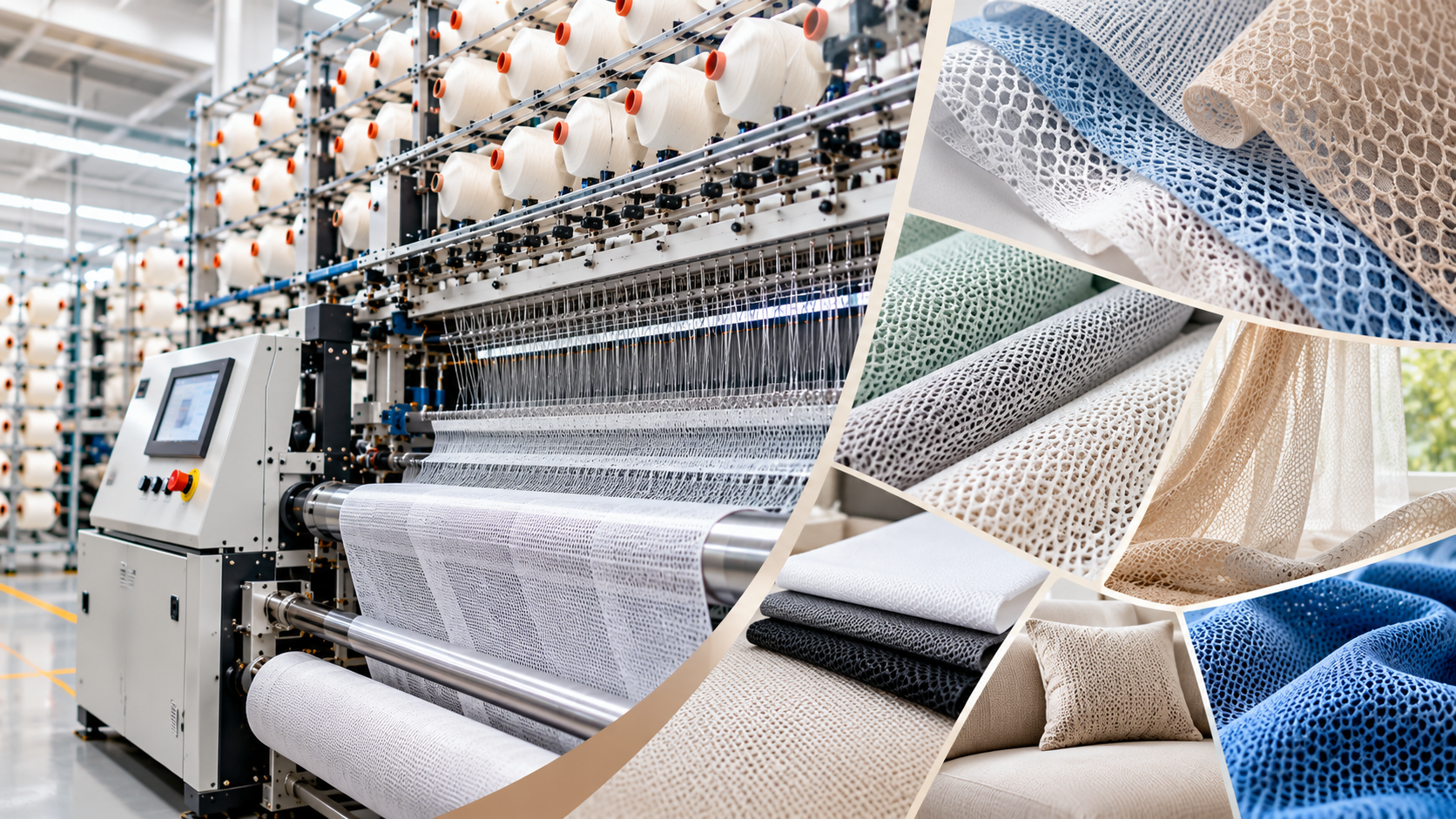
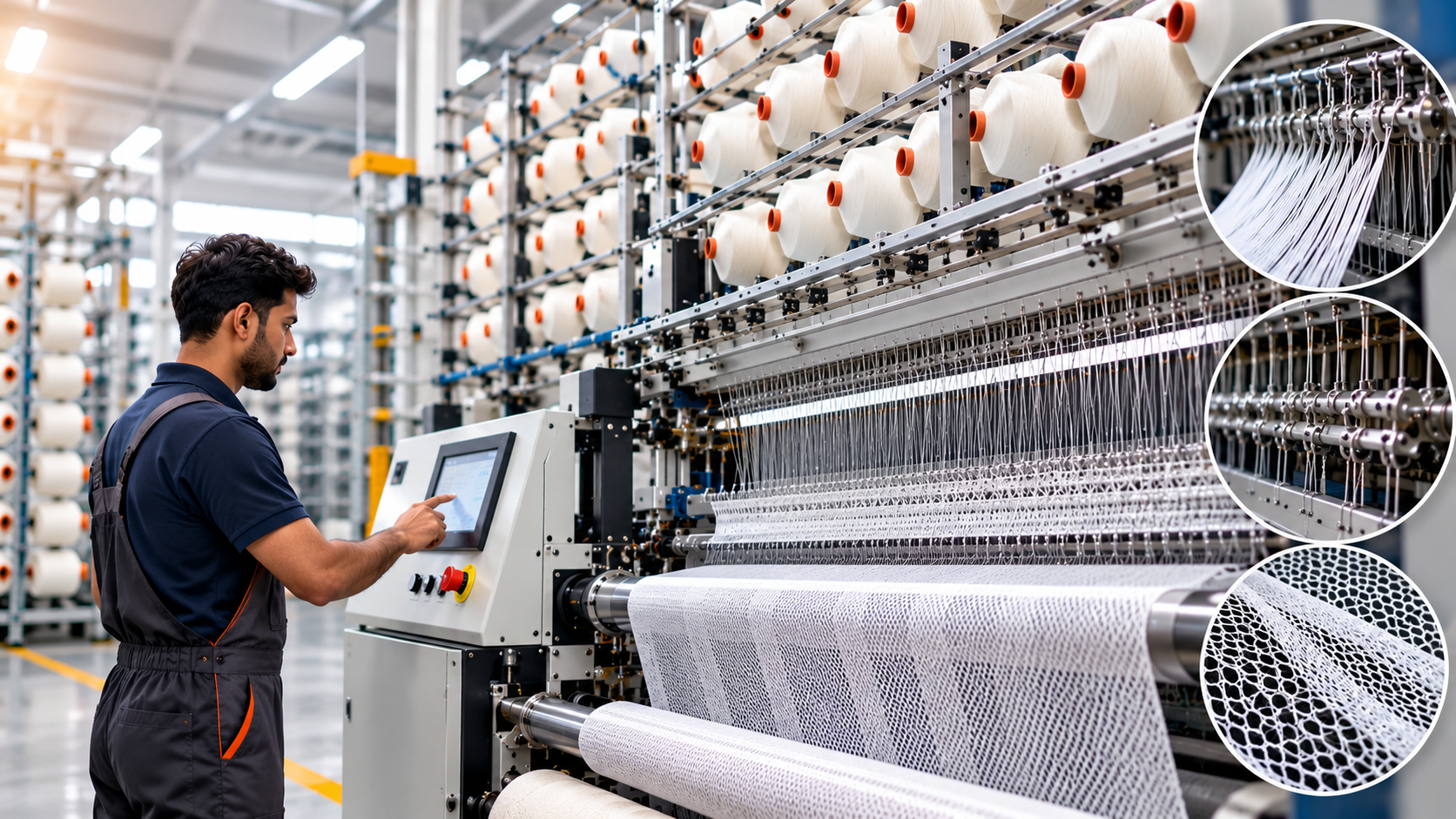
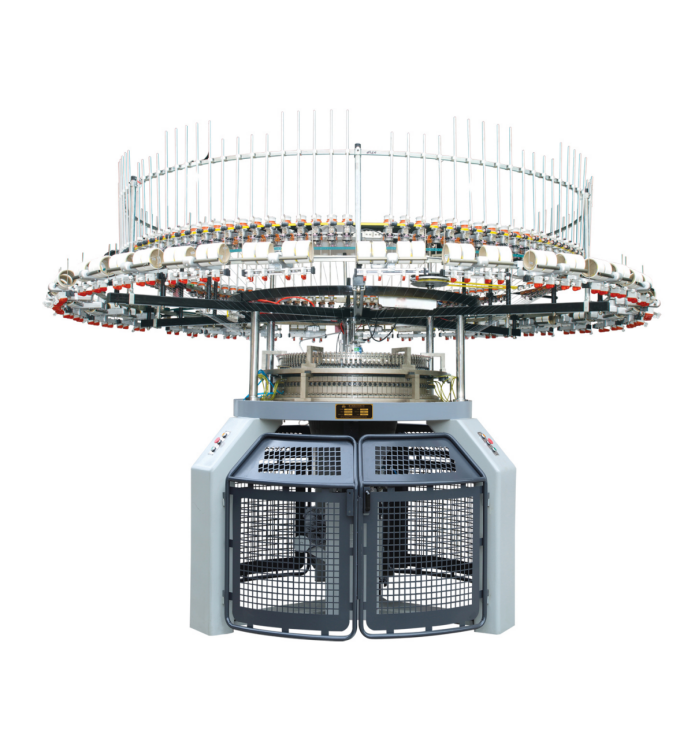
Discover which fabrics can be made on a warp knitting machine, including mesh, net, lining, sportswear, lingerie, spacer fabrics, and technical textiles.
A warp knitting machine can produce a wide range of fabrics, from lightweight garment linings and breathable mesh to lace, sportswear materials, and specialised technical textiles. The type of fabric depends on how the yarn loops are formed, the machine configuration, and the structure selected for production.
For textile businesses, understanding these fabric options helps when selecting machinery, planning production, and identifying suitable applications. Tricot and Raschel machines are two important types, each offering different fabric structures and production possibilities.
1. Mesh Fabrics
Mesh is one of the most common fabric categories associated with warp knitting. It has an open structure that allows air to pass through, with the size and shape of the openings depending on the knitting pattern, yarn, and machine setup.
Warp-knitted mesh fabrics are used in:
Sportswear panels and athletic garments
Shoe uppers and footwear components
Backpack and bag pockets
Ventilation panels
Furniture and seat coverings
Industrial mesh applications
Raschel machines are often suitable for more open mesh structures, while certain Tricot machines can produce finer mesh fabrics. The correct option depends on the required opening size, fabric strength, flexibility, and appearance.
2. Net and Lace Fabrics
Net and lace fabrics have open spaces or decorative patterns formed through the arrangement of knitted yarns. They may be lightweight and delicate or designed for stronger, more functional applications.
Common products include:
Fashion lace and decorative trims
Curtain nets and tulle
Lingerie overlays
Decorative garment panels
Sports nets
Agricultural and industrial netting
Raschel warp knitting machines are widely used for producing net and lace structures because their guide-bar arrangements allow different yarn movements and patterns. However, the required pattern complexity and fabric specifications must match the machine's capabilities.
3. Lining Fabrics
Lining fabrics are used inside garments to improve comfort, provide coverage, and help clothing slide more easily over other layers. Warp-knitted lining materials are valued for their smooth surface, light weight, and useful dimensional stability.
Applications include:
Jacket and coat linings
Garment inner layers
Pocket linings
Swimwear lining
Lightweight apparel linings
Selected footwear and accessory components
Tricot machines are commonly used for fine, smooth lining fabrics. The final result depends on yarn type, machine gauge, loop structure, fabric weight, and finishing treatments. Not every lining requires the same level of stretch or thickness, so these specifications should be decided before production.
4. Sportswear and Activewear Fabrics
Sportswear fabrics often need a combination of stretch, strength, comfort, breathability, and shape retention. Warp knitting can produce several fabric structures suited to these requirements.
Typical applications include:
Sportswear panels
Athletic garment linings
Breathable mesh sections
Stretch fabrics for fitted clothing
Swimwear materials
Selected performance and compression garment components
Polyester, nylon, and elastane-containing yarns may be used, depending on the required performance. The yarn composition alone does not determine fabric quality: the knitted structure and finishing process also affect stretch, recovery, feel, and breathability.
Tricot machines are often selected for fine, close-knit performance fabrics, while Raschel machines can produce open mesh and more complex structures. The best configuration depends on the intended garment and its performance requirements.
5. Lingerie and Intimate Apparel Fabrics
Lingerie fabrics need a suitable balance of softness, flexibility, coverage, and support. Warp knitting is widely used for materials that require a smooth surface or a controlled stretch structure.
Products may include:
Bra lining and selected cup materials
Underwear fabrics
Lingerie panels
Stretch mesh
Shapewear components
Decorative lace fabrics
Tricot structures are commonly used for smooth intimate apparel fabrics, while Raschel machines can produce lace, openwork, and power-net structures. Fabrics containing elastane can provide additional stretch, but the final performance depends on yarn selection, construction, and finishing.
6. Technical Textiles
Technical textiles are developed primarily for a particular function rather than appearance alone. Warp knitting can produce structures designed for strength, dimensional stability, airflow, cushioning, or reinforcement.
Examples include:
Automotive interior fabrics and selected seat components
Geotextile and reinforcement structures
Filtration and industrial mesh materials
Footwear reinforcement fabrics
Protective and medical textile components
Agricultural netting
Spacer fabrics for cushioning and ventilation
Some applications require additional yarns to be inserted into the knitted structure for reinforcement. Double-needle-bar Raschel machines can also produce three-dimensional spacer fabrics, in which two knitted surfaces are connected by spacer yarns.
Technical textile production requires careful assessment of the end-use specification. Strength, pore size, thickness, chemical resistance, and other performance properties may need to be tested against the intended application. Not all technical fabrics can be produced on a standard warp knitting machine.
7. Spacer Fabrics and Three-Dimensional Knitted Materials
Spacer fabrics have two knitted surfaces connected by yarns that maintain a space between them. This construction creates a three-dimensional material that can provide cushioning, airflow, and support.
Typical applications include:
Footwear components
Seat and upholstery materials
Mattress and cushioning layers
Selected sportswear padding
Breathable support materials
These fabrics generally require a suitable double-needle-bar machine configuration, such as an appropriate Raschel machine. The required thickness, connecting yarn, surface structure, and fabric performance must be considered when selecting the equipment.
8. Other Products Made with Warp Knitting
Beyond the main categories, warp knitting technology can produce a range of fashion, home textile, and industrial products.
Depending on the machine and construction, these may include:
Curtain fabrics and decorative drapes
Upholstery and selected furniture textiles
Pile fabrics and velvet-like structures
Carpet backing
Elastic or supportive textile structures
Specialised fabric bases for coating or lamination
Selected shoe and accessory materials
These are not universal capabilities of every machine. Some products require special guide bars, additional needle beds, specific yarn delivery systems, or dedicated machine configurations. Confirming the required fabric structure before choosing machinery helps avoid purchasing equipment that cannot meet the production target.
Tricot vs Raschel: Which Machine Is Suitable for Your Fabric?
Both machine types produce warp-knitted fabrics, but their typical applications differ.
Fabric requirement
Common machine option
Main consideration
Fine lining fabrics
Tricot
Smooth surface and fabric weight
Fine lingerie materials
Tricot
Softness, stretch, and coverage
Lightweight sportswear fabrics
Tricot or suitable Raschel
Required stretch and structure
Open mesh and net
Raschel or suitable Tricot
Opening size and strength
Decorative lace
Raschel
Pattern complexity
Three-dimensional spacer fabric
Double-needle-bar Raschel
Spacer thickness and structure
Selected industrial reinforcement fabrics
Specialised Raschel configurations
Strength and end-use requirements
These are general selection guidelines, not strict rules. Machine capabilities overlap, and the final choice depends on the model, gauge, guide-bar arrangement, yarn, and required fabric construction.
What Determines Which Fabric a Warp Knitting Machine Can Produce?
Before choosing a machine, assess these important factors.
Machine type: Tricot and Raschel machines have different construction options and are commonly used for different fabric categories.
Gauge: Gauge refers to the needle spacing or needle density of the machine. It influences the fineness of the knitted structure, but it does not determine fabric thickness or quality by itself.
Yarn type: Polyester, nylon, elastane-containing yarns, and other suitable materials can be used according to the machine and product requirements.
Knitting structure: Guide-bar movements, lapping patterns, needle-bed arrangement, and additional yarns influence the fabric's openness, stretch, texture, and stability.
Working width: The machine's usable width must suit the intended fabric dimensions and production plan.
Finishing requirements: Dyeing, heat setting, coating, lamination, or other finishing steps may change the final fabric properties.
Production target: Consider the required output, fabric quality, machine speed, changeover requirements, and availability of trained operators.
Is a Textile Warping Machine Also Required?
A warp knitting machine forms the fabric, while a textile warping machine prepares yarns by arranging and winding them onto warp beams in a controlled, parallel sheet. Warp preparation is an important part of many production setups because the yarn supply must meet the knitting machine's requirements.
Depending on the machinery arrangement, a textile business may need a separate warping machine or may source prepared warp beams from another supplier. The decision depends on production volume, yarn requirements, beam specifications, and the factory's workflow.
A warp machine should therefore be evaluated as part of the complete production process, not only by its knitting speed. Yarn preparation, beam handling, fabric inspection, and finishing can all affect the efficiency of the overall operation.
Choosing the Right Warp Knitting Machine with Ramana Machines
Selecting machinery starts with understanding the fabric you want to produce. A machine suitable for fine lining may not be suitable for heavy netting or three-dimensional spacer fabric. Reviewing the intended application, yarn, gauge, working width, structure, and production target can help narrow down suitable options.
Ramana Machines supports textile businesses with machinery sourcing, import and distribution, machine selection, installation assistance, operator guidance, spare parts, and after-sales technical support. As a textile machinery supplier, we help buyers assess equipment according to their production requirements and intended fabric applications.
For businesses looking for a textile supplier trader in India, it is useful to evaluate the supplier's machinery range, sourcing support, documentation, availability of spare parts, and technical assistance alongside the machine specifications. Ramana Machines can help textile businesses explore suitable machinery options for their planned production needs.
Find answers to the most common questions about our machines, services and support.
Warp knitting machines can produce mesh, net, lace, lining, lingerie fabrics, sportswear materials, upholstery fabrics, spacer fabrics, and selected technical textiles. The exact range depends on the machine configuration and knitting structure.
Yes. Suitable Tricot and Raschel machines can produce mesh. The choice depends on the required opening size, yarn, fabric weight, strength, and application.
Tricot machines are commonly used for fine, smooth lining fabrics. The correct machine and settings depend on the required thickness, surface, yarn, and fabric performance.
Yes. They can produce selected sportswear fabrics, breathable mesh, linings, and stretch materials. The machine, yarn, and structure must suit the garment's stretch, comfort, and durability requirements.
Tricot machines are widely used for smooth lingerie fabrics, while suitable Raschel machines can produce lace, net, and supportive mesh structures.
Tricot fabrics are often fine, smooth, and closely knitted. Raschel fabrics can include open mesh, lace, net, textured structures, and some technical materials. Actual capabilities vary by machine model.
Yes. Specialised configurations can produce selected automotive textiles, reinforcement materials, geotextile structures, filtration fabrics, and spacer textiles. The machine must be designed for the required construction.
Some machines can produce multiple fabrics, provided their structures and production requirements are within the machine's capabilities. Changing fabrics may require different yarns, settings, guide-bar movements, or other adjustments.
Gauge describes needle spacing or needle density. It influences the fineness of the structure and the types of constructions that can be produced, but yarn and knitting pattern also affect the final fabric.
Polyester and nylon are common choices, while elastane and other suitable yarns may be used for specific applications. The right yarn depends on the fabric's strength, stretch, feel, and end use.
A textile warping machine arranges yarn ends in parallel and winds them onto a warp beam for use in downstream processes such as warp knitting. Proper beam preparation supports consistent yarn delivery.
Check the intended fabric, machine type, gauge, working width, yarn compatibility, guide-bar arrangement, production capacity, spare parts, installation requirements, and after-sales support.
Yes, suitable double-needle-bar machines can produce three-dimensional spacer fabrics. These are used in selected footwear, cushioning, upholstery, and breathable support applications.
Start with the fabric sample or product specification. Then compare suitable machine types, gauge, width, yarn requirements, production volume, and service support before making a decision.