
Blog
Which Warp Knitting Machine Is Suitable for Terry, Velvet, or Pile Fabrics?
By Ramana Machines · October 10, 2026
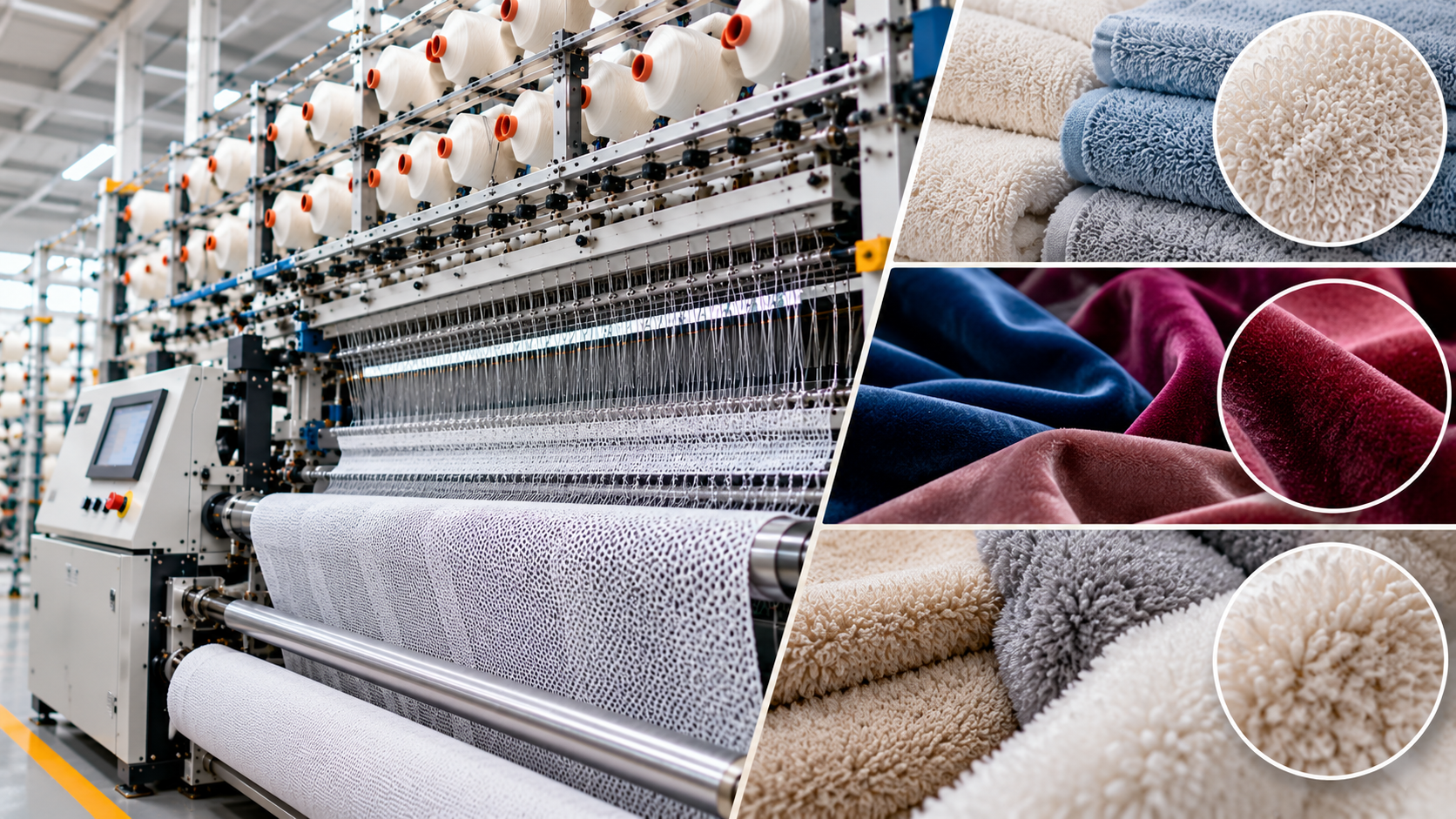
Learn which knitting machines are suitable for terry, velvet, and pile fabrics. Explore machine configurations, yarn selection, fabric structure, finishing, and buying considerations.
Terry, velvet, and pile fabrics are known for their soft surfaces, raised loops, or textured appearance. They are used in products such as towels, upholstery, blankets, clothing, footwear, and home textiles. However, these fabrics do not all require the same knitting process or machine configuration.
When choosing a warp knitting machine for pile fabric production, it is important to understand the required fabric structure, machine design, yarn properties, and finishing process. A machine suitable for one type of pile fabric may not be suitable for another.
1. Understanding Terry, Velvet, and Pile Fabrics
Although these fabrics may look similar because of their textured surfaces, their construction can be different.
Terry fabric usually has loops that extend from the fabric surface. These loops create a soft, absorbent texture commonly associated with towels and bath products. Many conventional terry towels are made using specialised terry weaving machines rather than warp knitting machines. Warp-knitted loop fabrics are possible, but the machine must be designed for the required construction.
Velvet fabric has a dense, soft pile surface. The pile may be created through different textile processes, including weaving, knitting, or other specialised fabric construction methods. Warp-knitted velvet-like fabrics require a machine configuration capable of forming and controlling the pile structure.
Pile fabric is a broader category in which loops or cut yarn ends rise above the base fabric. Depending on the construction, pile fabrics can be soft, thick, decorative, or designed for specific functional uses.
Before selecting machinery, confirm whether the intended product requires loop pile, cut pile, a raised surface, or another type of textured structure.
2. Which Warp Knitting Machine Is Suitable?
The right machine depends on the construction of the fabric rather than its commercial name alone.
Raschel Warp Knitting Machine
Raschel machines can produce a broad range of fabric structures, including mesh, lace, openwork, and certain specialised textured fabrics. Some specialised Raschel configurations can produce pile or spacer structures, depending on their needle-bed arrangement and other machine features.
A suitable double-needle-bar Raschel machine, for example, can produce three-dimensional spacer fabric. However, spacer fabric is not automatically the same as traditional terry or velvet. The required pile structure must be supported by the specific machine design.
Tricot Warp Knitting Machine
Tricot machines are commonly used for fine, smooth, lightweight, and stretch fabrics. Their typical applications include lining materials, lingerie fabrics, sportswear, and selected technical textiles.
A standard Tricot machine should not be assumed to produce conventional terry or velvet pile. If a raised or textured surface is required, check whether the particular machine model is designed for that structure.
Specialised Pile or Velvet Knitting Machine
Some pile fabrics require specialised machinery designed to form and control loops or pile yarns. Depending on the product, a dedicated pile knitting machine or a different textile process may be more appropriate than a standard warp knitting machine.
Important: Not every warp knitting machine can produce every pile fabric. Always confirm the required fabric construction and the machine's documented capabilities before purchasing equipment.
3. How Machine Configuration Affects Pile Fabric Production
Machine configuration determines how yarn is supplied, how loops are formed, and how the fabric structure is controlled.
When evaluating machinery, consider the following:
- Needle-bed arrangement: Single-bed and double-needle-bar configurations support different fabric structures. The appropriate arrangement depends on the intended construction.
- Guide bars: Their number and movement affect yarn placement and the formation of the knitted structure.
- Gauge: Gauge influences the fineness of the knitting structure and the possible fabric construction.
- Working width: The usable width must suit the product dimensions and production requirements.
- Yarn delivery: The machine must supply the base yarn and any pile yarn consistently.
- Take-down system: The fabric must be removed from the knitting area under suitable conditions to maintain a stable structure.
- Machine controls: Suitable controls help operators maintain repeatable settings and monitor production.
The exact combination of features varies between machine models. It is better to compare the technical specifications against the required fabric sample than to select a machine based only on its general category.
4. Choosing the Right Yarn
Yarn selection affects the fabric's softness, strength, surface appearance, durability, and ability to hold its intended structure.
Depending on the product and machine, possible yarn choices include polyester, nylon, cotton, and other suitable fibres or blends.
For terry-style fabrics: Yarn selection should consider loop stability, softness, absorbency, and the intended use. If absorbency is essential, fibre type and finishing are particularly important.
For velvet-like fabrics: The pile yarn should provide the required softness, coverage, and surface appearance. Yarn strength and uniformity can affect pile consistency.
For general pile fabrics: The base yarn must provide suitable support, while the pile yarn must work with the intended loop or surface construction.
Yarn count, twist, elasticity, thickness, and quality should be matched to the machine's capabilities. Inconsistent yarn or unsuitable tension can lead to irregular loops, missing pile, yarn breakage, and uneven fabric surfaces.
5. Why Fabric Structure Matters
The knitting structure determines how the fabric behaves and how its surface looks. Two fabrics made from similar yarns can have very different properties because their structures differ.
Important factors include:
- Loop size and arrangement
- Pile height or loop height
- Density of the base structure
- Spacing between knitted elements
- Yarn placement and guide-bar movement
- Fabric thickness and weight
- Stability after production and finishing
For example, a soft looped surface for a towel-like product has different requirements from a dense velvet-like surface used in upholstery. These requirements must be translated into a suitable machine configuration and knitting structure.
Where possible, use an approved fabric sample or technical specification when discussing machine selection with a supplier.
6. Finishing Requirements for Terry, Velvet, and Pile Fabrics
Knitting is only one part of the production process. Finishing may be needed to achieve the final surface, feel, dimensions, or performance.
Depending on the fibre and fabric construction, finishing processes may include:
- Washing and cleaning
- Dyeing or colour development
- Heat setting for suitable synthetic fabrics
- Brushing or raising to improve surface softness
- Shearing to level the pile surface
- Surface polishing or other fabric-specific treatments
Not every fabric needs every process. For example, heat setting must be suitable for the fibre and fabric construction, while shearing is used only when the product requires a more level pile surface.
The finishing line should be selected according to the final product specification. If the fabric is intended for towels, upholstery, footwear, or clothing, its absorbency, softness, colourfastness, surface quality, and dimensional stability may require different checks.
7. Common Problems in Pile Fabric Production
Pile fabric production can be affected by machine settings, yarn quality, incorrect threading, and unsuitable finishing conditions.
Uneven pile height: Check yarn delivery, machine settings, knitting structure, and the consistency of the finishing process.
Missing loops or pile: Inspect the yarn path, needles, guides, and other knitting elements relevant to the machine configuration.
Yarn breakage: Check yarn quality, tension, damaged guides, and friction along the yarn path.
Uneven fabric surface: Compare the fabric across its width and inspect yarn consistency, loop formation, and finishing conditions.
Fabric stretching or distortion: Review take-down tension, fabric handling, and any heat-setting or finishing parameters used.
Always stop the machine safely before inspecting moving components. Complex adjustments to guide bars, needle timing, or machine mechanisms should be performed by qualified personnel.
8. How to Choose the Right Machine for Your Production
Before buying machinery, define the product you want to make and confirm the required fabric structure. Then review the following points:
- Fabric application: Identify whether you need terry-style loops, velvet-like pile, spacer fabric, or another raised surface.
- Machine suitability: Confirm that the machine is designed to produce that exact construction.
- Yarn compatibility: Check the permitted yarn types, counts, and delivery requirements.
- Production capacity: Compare working width, speed, output needs, and changeover requirements.
- Finishing requirements: Identify whether brushing, shearing, heat setting, or other treatments are needed.
- Maintenance and spare parts: Consider component availability and the maintenance skills required.
- Technical support: Check whether installation assistance, operator training, and after-sales service are available.
When comparing the best warp knitting machine in Ludhiana, buyers should focus on suitability for the intended fabric, verified machine specifications, and long-term support rather than relying on price or general machine descriptions alone.
Machinery Selection Support from Ramana Machines
Ramana Machines supports textile businesses with machinery sourcing, import and distribution, machine selection, installation assistance, operator guidance, spare parts, and after-sales technical support. We help buyers assess equipment according to their required fabric structure, production needs, and operating requirements.
For businesses looking for a textile machinery supplier in Ludhiana, it is important to verify machine capabilities, spare parts availability, documentation, and technical support before making a purchase. Ramana Machines can help textile businesses explore suitable machinery options based on their production requirements.
Related
More insights
10 Oct 2026
Why Does Yarn Keep Breaking on a Warp Knitting Machine? Causes, Troubleshooting and Prevention
View10 Oct 2026
Why Does Yarn Keep Breaking on a Warp Knitting Machine? Causes, Troubleshooting and Prevention
Learn why yarn breaks on warp knitting machines and how yarn quality, tension, damaged guides, beam unwinding and feeding affect production.
View
10 Oct 2026
Which Fabrics Can Be Made on a Warp Knitting Machine? A Guide to Types and Uses
View10 Oct 2026
Which Fabrics Can Be Made on a Warp Knitting Machine? A Guide to Types and Uses
Discover which fabrics can be made on a warp knitting machine, including mesh, net, lining, sportswear, lingerie, spacer fabrics, and technical textiles.
View
10 Oct 2026
How to Operate a Warp Knitting Machine: A Step-by-Step Beginner’s Guide
View10 Oct 2026
How to Operate a Warp Knitting Machine: A Step-by-Step Beginner’s Guide
Learn how to operate a warp knitting machine, including yarn loading, threading, machine settings, fabric inspection, troubleshooting, and maintenance.
ViewFrequently Asked Questions
Find answers to the most common questions about our machines, services and support.
The correct machine depends on the required pile construction. Some specialised knitting machines can produce velvet-like fabrics, but a standard Tricot or Raschel machine should not be assumed to have this capability without checking its specifications.
Certain specialised knitting configurations can produce looped or terry-style structures. However, conventional terry towels are commonly produced using specialised terry weaving machinery. Confirm the required fabric construction before selecting a machine.
Terry usually features surface loops, velvet generally has a dense and soft pile surface, and pile is the broader term for fabrics with raised loops or yarn ends.
Not necessarily. Raschel machines have a wide range of capabilities, but pile production depends on the specific machine configuration and its intended fabric structures.
Standard Tricot machines are commonly used for fine and smooth fabrics. For velvet-like pile, buyers should verify whether the particular model supports the required pile construction.
There is no single best yarn for every pile fabric. Polyester, nylon, cotton, and blends may be suitable depending on the product, machine, softness, durability, absorbency, and finishing requirements.
Gauge influences needle spacing and the fineness of the knitted structure. It should be selected along with yarn specifications, pile requirements, and the intended fabric weight.
Depending on the material, finishing may include washing, dyeing, heat setting, brushing, raising, or shearing. The correct process depends on the fibre, fabric structure, and required surface.
Possible causes include inconsistent yarn delivery, incorrect machine settings, irregular loop formation, worn components, or uneven finishing. The machine and fabric should be checked systematically.
Confirm the required pile structure, machine configuration, gauge, working width, yarn compatibility, production capacity, finishing needs, spare parts availability, and technical support.
No. These fabrics can require different constructions and machine features. A machine should be selected for the specific fabric structures it is designed to produce.
Ramana Machines supports buyers with machinery sourcing, selection guidance, installation assistance, spare parts, and after-sales technical support according to their production requirements.