Blog
Why Does Yarn Keep Breaking on a Warp Knitting Machine? Causes, Troubleshooting and Prevention
By Ramana Machines · October 10, 2026
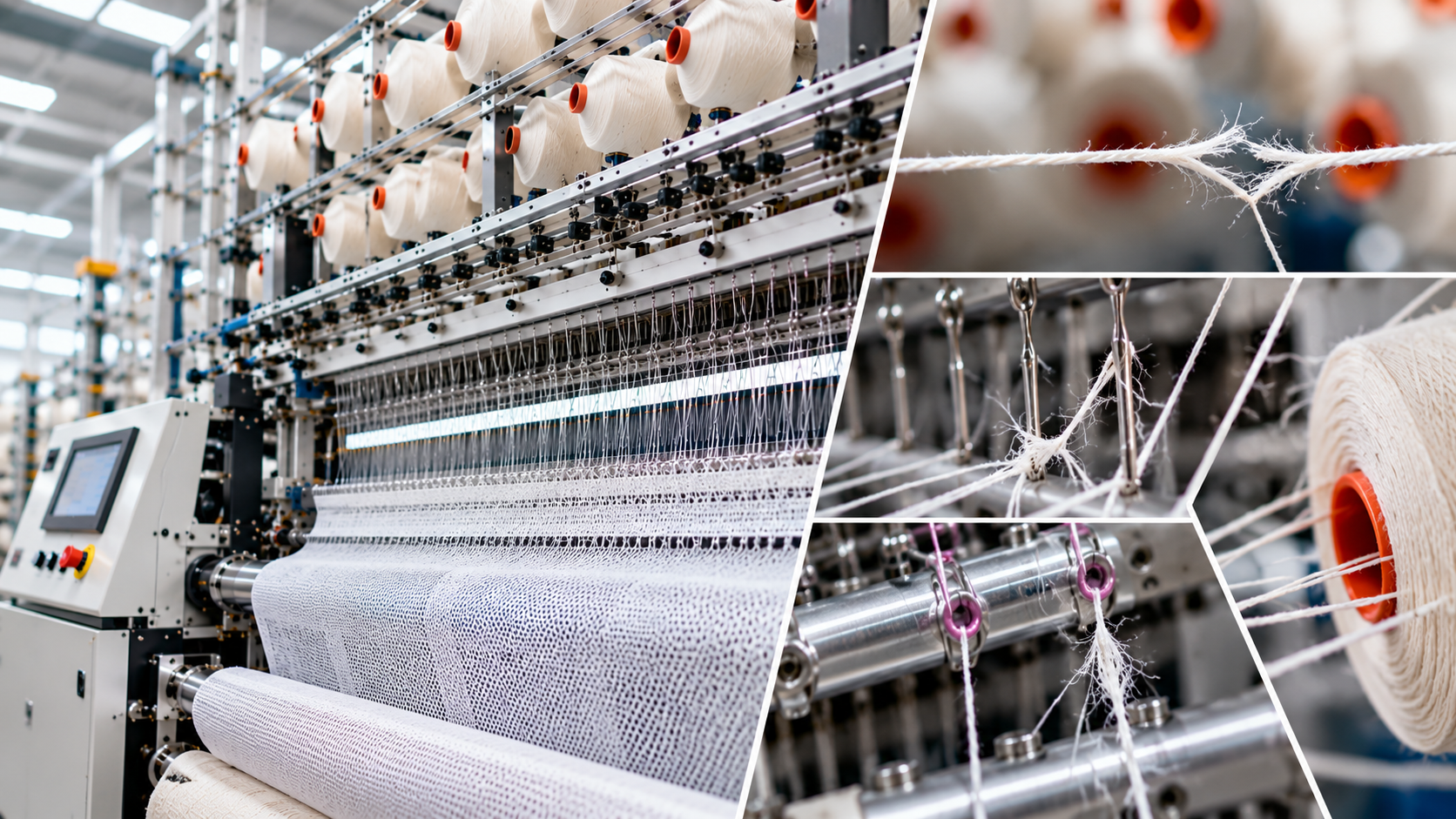
Learn why yarn breaks on warp knitting machines and how yarn quality, tension, damaged guides, beam unwinding and feeding affect production.
Common Causes of Yarn Breakage on Warp Knitting Machines
Frequent yarn breakage on a warp knitting machine can reduce production efficiency, increase machine downtime, create fabric defects, and raise yarn wastage. Even a small number of yarn breaks can affect fabric uniformity, machine productivity, and overall manufacturing costs when they occur repeatedly during a production shift.
Yarn breakage in warp knitting is generally associated with yarn quality, excessive or uneven yarn tension, damaged yarn guides, incorrect beam unwinding, inconsistent yarn feeding, and improper machine settings. Identifying the actual cause is essential because increasing yarn tension or repeatedly restarting the machine without correcting the underlying problem may lead to further breakage.
A systematic troubleshooting process should examine the yarn package, creel arrangement, warp beam, tensioning components, yarn guides, feeding system, knitting elements, and operating conditions.
1. Poor Yarn Quality and Yarn Defects
Yarn quality is one of the most important factors affecting the performance of a warp knitting machine. Yarn with inconsistent tensile strength, excessive hairiness, uneven thickness, weak places, knots, or contamination may break when subjected to the continuous tension and movement involved in warp knitting.
Yarn quality problems that cause breakage
- Low tensile strength: Yarn may not withstand the tension applied during unwinding and knitting.
- Uneven yarn count: Variations in yarn thickness can create inconsistent feeding and localized stress.
- Excessive hairiness: Protruding fibres may catch on guides, needles, or other machine components.
- Weak places and slubs: Localized defects can become breakage points under tension.
- Knots and splices: Poorly formed knots or bulky splices may snag on guides or knitting elements.
- Moisture and storage issues: Unsuitable storage conditions can affect some yarn types, especially when combined with contamination or degradation.
How to troubleshoot yarn quality issues
First, inspect the broken yarn ends and determine whether the break occurs at random positions or repeatedly at the same location. Examine yarn packages for visible defects and compare yarn from different packages or lots. If breakage increases with a particular lot, check its tensile strength, evenness, hairiness, and other relevant quality parameters.
Where possible, use yarn testing equipment to assess breaking force and elongation against the yarn specification. Confirm that the yarn count, material, and construction are suitable for the machine gauge, fabric structure, and production speed.
Preventive measure: Purchase yarn from reliable suppliers, maintain consistent yarn specifications, store packages appropriately, and perform incoming yarn quality checks before production.
2. Incorrect or Excessive Yarn Tension
Incorrect yarn tension is a major cause of yarn breakage in warp knitting machines. Every yarn must unwind from its package or warp beam and travel through the feeding path at a suitable tension. If the tension becomes excessive, fluctuates sharply, or differs significantly between yarn ends, the yarn may break or produce uneven fabric.
How excessive tension develops
- Incorrect tension settings on individual yarn ends or warp beams.
- Uneven tension across the width of the machine.
- Over-tightened tensioning devices or incorrectly adjusted yarn brakes.
- Excessive friction in the yarn path.
- Incorrect machine speed for the yarn being processed.
- Poor beam preparation or uneven yarn winding.
- Sudden changes in tension during machine acceleration or deceleration.
In warp knitting, tension must be considered across the entire yarn path rather than at only one point. A yarn may have acceptable tension near the beam but experience a sharp increase as it passes through a guide, tensioning device, or feeding element.
How to check yarn tension
- Measure yarn tension using a suitable tension meter at the recommended inspection points.
- Compare tension across multiple ends and across the full machine width.
- Check whether the tension changes when the machine accelerates, slows down, or runs continuously.
- Inspect tensioning devices, yarn brakes, and guide rollers for incorrect adjustment or excessive friction.
- Adjust the settings according to the machine manufacturer's instructions and the yarn specification.
Avoid applying one universal tension setting to every yarn type. Filament yarn, spun yarn, elastane, textured yarn, and other materials can behave differently under the same operating conditions.
Preventive measure: Establish documented tension settings for each yarn type, machine configuration, and fabric construction. Regularly monitor tension stability rather than relying only on manual adjustment.
3. Damaged, Dirty, or Misaligned Yarn Guides
Yarn guides direct the yarn through the machine along a controlled path. Damaged or contaminated guides can create friction, abrasion, and localized stress, eventually causing yarn breakage. If the yarn repeatedly breaks at the same position, the guide or another component along that particular yarn path should be inspected carefully.
Common guide-related problems
- Scratches, burrs, or sharp edges on ceramic or metallic guides.
- Worn guide surfaces caused by prolonged operation.
- Lint, oil deposits, dust, or fibre accumulation.
- Misaligned guides that force the yarn to change direction abruptly.
- Incorrect guide positioning after maintenance.
- Loose or damaged guide holders and mounting components.
Even a small burr can damage fine filaments or weaken a yarn surface. In addition to breakage, guide-related friction may cause fuzziness, filament damage, uneven yarn delivery, and fabric defects.
Inspection and maintenance procedure
Stop the machine and follow the manufacturer's safety and isolation procedures before inspecting yarn guides. Examine the complete yarn path, including guide eyes, ceramic inserts, tensioning elements, feeder components, and other contact points.
Clean the guides using a method suitable for their material. Replace components that have scratches, burrs, excessive wear, or visible damage. Check alignment and ensure that yarn travels smoothly without unnecessary rubbing.
Preventive measure: Include yarn guides and other yarn-contact components in the preventive maintenance schedule. If the same end breaks repeatedly at the same point, inspect that exact yarn path before changing the overall machine settings.
4. Warp Beam Unwinding Problems
Warp beam unwinding plays a critical role in maintaining consistent yarn tension during warp knitting. A properly prepared beam should deliver yarn smoothly and uniformly as the machine operates. Problems with beam winding, mounting, braking, or unwinding can create tension fluctuations that lead to repeated yarn breaks.
Common warp beam problems
Uneven beam winding: Variations in winding density or yarn tension during warping may cause some ends to unwind differently from others.
Incorrect beam mounting: Improper positioning or alignment can affect yarn delivery and introduce unnecessary friction.
Unstable braking or let-off: An incorrectly adjusted or malfunctioning let-off system may cause excessive tension, slack yarn, or fluctuating yarn delivery.
Damaged or poorly prepared yarn ends: Weak ends, crossed yarns, and winding defects can become breakage points during operation.
Beam runout or mechanical issues: Irregular beam rotation, bearing problems, or other mechanical faults may disturb the unwinding process.
How to diagnose beam unwinding issues
Check whether yarn breaks occur across a large section of the machine width or are concentrated around specific ends or beams. Widespread tension fluctuations may indicate a beam preparation, let-off, braking, or mechanical problem. Breakage concentrated around one section may indicate localized winding defects, damaged yarn ends, or alignment issues.
Inspect beam mounting, rotation, bearings, braking arrangements, and let-off operation according to the machine design. Verify that the warp beam was prepared with consistent winding conditions and suitable yarn tension.
An automatic warping machine can support consistent warp preparation by controlling relevant winding parameters and improving process repeatability. However, it cannot compensate for every yarn defect or eliminate breakage caused by incorrect knitting-machine settings, damaged guides, or unsuitable yarn.
Preventive measure: Maintain appropriate warping tension, inspect beams before loading, verify beam alignment, and monitor let-off performance during production.
5. Inconsistent Yarn Feeding and Feed System Problems
The yarn feeding system must deliver the required quantity of yarn consistently to the knitting zone. Irregular feeding can increase yarn tension, create slack, disturb loop formation, and cause yarn breakage.
The exact feeding arrangement depends on the warp knitting machine design. Some machines use different forms of controlled yarn delivery, while others rely on machine-specific let-off and feed mechanisms.
Factors affecting yarn feeding
- Incorrect feeding or let-off settings.
- Excessive friction at feed rollers or yarn contact points.
- Dirty, worn, or slipping feed components.
- Inconsistent yarn delivery between beams or yarn ends.
- Incorrect speed synchronization between feeding and knitting systems.
- Poorly adjusted tensioning components.
- Sudden acceleration or changes in operating conditions.
Troubleshooting yarn feeding issues
Observe whether the yarn breaks during machine startup, acceleration, steady production, or speed changes. If breakage mainly occurs during acceleration, inspect the machine's start-up procedure, let-off response, and feeding synchronization.
Check feed rollers, tensioning elements, yarn paths, and relevant control settings. Verify that the feeding system is operating according to the manufacturer's recommended procedure. Where electronic control systems are fitted, review relevant alarms and available operating data.
Preventive measure: Keep feeding components clean, maintain proper alignment, verify synchronization, and establish a controlled start-up procedure for each fabric and yarn specification.
6. Worn Needles, Needle Bars, and Knitting Elements
Yarn breakage does not always originate in the yarn supply system. Damaged knitting elements can catch, scrape, or overstress yarn as loops are formed.
Depending on the machine type, relevant components may include knitting needles, guide needles, compound needles, sinkers, guide bars, and other loop-forming elements.
Signs of knitting-element problems
- Yarn repeatedly breaks near the knitting zone.
- Fabric develops holes, dropped loops, or irregular stitches.
- Breakage occurs at a consistent machine position.
- Unusual noise or vibration develops during operation.
- Needles or other components show visible wear or damage.
Inspect the relevant knitting elements for bending, burrs, wear, incorrect positioning, and damage. Check timing, clearances, and alignment against the manufacturer's specifications. Do not alter needle timing or other precision settings without the appropriate technical procedure.
Preventive measure: Replace damaged components promptly and perform scheduled inspections of needles, guide bars, sinkers, and related knitting elements.
7. Excessive Machine Speed and Incorrect Operating Settings
Higher production speed can increase the demands placed on the yarn, feeding system, and knitting elements. If yarn quality, tension control, beam preparation, or machine condition is unsuitable for the selected speed, the risk of yarn breakage may increase.
However, machine speed alone is not always the cause. A machine operating at a moderate speed may still experience frequent breaks because of damaged guides, inconsistent yarn quality, or incorrect tension.
How to identify speed-related breakage
Compare the breakage rate at different approved operating speeds while keeping other production variables as consistent as possible. Record the number of yarn breaks, downtime, fabric quality, and production output.
If breakage increases significantly at higher speeds, investigate tension stability, beam let-off, yarn feeding, machine vibration, and the condition of yarn-contact components. Adjust speed within the manufacturer's recommended operating range.
Preventive measure: Increase speed gradually after confirming stable yarn delivery and acceptable fabric quality. Use documented machine settings for each fabric construction rather than operating at the highest possible speed by default.
8. Environmental Conditions and Yarn Handling
Temperature, humidity, dust, and yarn storage conditions can affect yarn behaviour, although their influence depends on the fibre type, yarn construction, and manufacturing environment.
Excessively dry conditions may increase static-related handling problems for some synthetic yarns. Dust and lint can accumulate on guides and feeding components, while unsuitable storage may affect yarn consistency or introduce contamination.
Recommended environmental controls
- Maintain clean production areas and remove lint from machine components.
- Store yarn in conditions appropriate to the fibre and supplier's recommendations.
- Avoid unnecessary handling that can damage packages or yarn surfaces.
- Monitor static electricity where it affects yarn movement.
- Use appropriate cleaning procedures and keep lubricants away from yarn paths unless the machine design specifically requires them.
Environmental conditions should be evaluated alongside tension, yarn quality, and machine condition rather than treated as the only explanation for yarn breakage.
9. A Practical Troubleshooting Checklist for Warp Knitting Yarn Breakage
Use the following checklist to identify the likely source of repeated yarn breaks systematically.
Observation | Possible cause | Recommended action |
| Breaks occur at random positions | Yarn quality variation or inconsistent tension | Inspect yarn lots and measure tension |
| The same yarn end breaks repeatedly | Local guide damage, yarn defect, or alignment issue | Trace and inspect the complete yarn path |
| Breaks increase during acceleration | Feeding or let-off response, tension fluctuation | Review start-up settings and synchronization |
| Several adjacent ends break | Beam preparation, localized guide damage, or uneven tension | Inspect the affected beam section and guides |
| Breaks increase at higher speeds | Operating conditions, tension instability, or mechanical vibration | Test approved lower speeds and inspect the system |
| Breakage occurs near the knitting zone | Worn or misaligned knitting elements | Inspect needles and related components |
| Yarn shows abrasion or fuzziness | Excessive friction or damaged contact surfaces | Check guides, rollers, and yarn-contact points |
| Breakage follows a new yarn lot | Yarn specification or quality variation | Compare test results and yarn specifications |
Record yarn breaks to find recurring patterns
A basic yarn breakage log should include the date, machine identification, fabric construction, yarn type and count, machine speed, beam number, broken-end position, and suspected cause.
Record the number of breaks per shift and the downtime associated with each incident. Where production volume is available, a useful indicator is the number of yarn breaks per 1,000 machine-hours or per another consistently defined production unit. Always use the same measurement basis when comparing machines, shifts, or yarn lots.
This information helps maintenance and production teams distinguish between isolated incidents and recurring process problems.
10. How Preventive Maintenance Reduces Yarn Breakage
Preventive maintenance reduces avoidable downtime by identifying wear, contamination, and adjustment problems before they cause repeated production interruptions.
A practical maintenance programme should cover:
- Before production: Check yarn packages, beam mounting, yarn paths, tension settings, and the condition of visible machine components.
- During production: Monitor yarn breaks, tension consistency, abnormal sounds, machine vibration, and fabric defects.
- After production: Clean accessible yarn-contact areas and document recurring problems.
- At scheduled intervals: Inspect guides, rollers, needles, guide bars, bearings, brakes, and feeding or let-off components as applicable.
- After maintenance or changeovers: Verify component alignment, machine settings, and yarn routing before returning to normal production.
Follow the machine manufacturer's instructions for cleaning, lubrication, replacement intervals, and safety procedures. Always stop and isolate the machine as required before inspecting or servicing moving components.
11. Does Machine Selection Affect Yarn Breakage?
Machine design, control systems, yarn path geometry, feeding arrangements, and maintenance conditions can influence the stability of warp knitting production. However, no machine can guarantee zero yarn breakage because performance also depends on yarn properties, beam preparation, fabric construction, operating settings, and maintenance practices.
When evaluating a warp knitting machine, manufacturers should consider the intended yarn materials, yarn counts, fabric applications, operating speed, tension-control requirements, availability of spare parts, and technical support.
Chinese warp knitting machines are available in different configurations for different textile applications. Buyers should compare the technical specifications, machine configuration, suitability for their intended fabrics, service support, and spare-parts availability instead of selecting equipment based on price alone.
An automatic warping machine may also be relevant when evaluating the complete production process because consistent warp preparation can help reduce avoidable tension variation and winding-related defects.
For businesses sourcing equipment, working with a reliable textile machinery trading company in India can help simplify machine selection, specification comparison, supplier coordination, and after-sales support arrangements. Buyers should confirm the exact scope of technical support and service offered before purchasing.
Reliable Warp Knitting Solutions from Ramana Machines
Ramana Machines supports textile manufacturers and industrial buyers in exploring machinery solutions suited to their production requirements. When evaluating warp knitting equipment, buyers should consider the intended fabric applications, yarn compatibility, operating requirements, machine configuration, and availability of technical support. A well-matched machine, combined with correct yarn preparation, stable tension control, and preventive maintenance, can help improve production consistency and reduce avoidable downtime.
As a supplier of textile machinery, Ramana Machines assists buyers in identifying suitable machinery options for their manufacturing needs. Whether you are evaluating warp knitting machines or other textile production equipment, selecting machinery based on technical suitability, reliable sourcing, and long-term operational requirements is essential for building an efficient textile manufacturing process. Contact Ramana Machines to discuss your machinery requirements and explore suitable equipment options for your business.