Blog
Why Is an Embossing Machine Not Maintaining Consistent Pressure?
By Ramana Machines · November 13, 2026
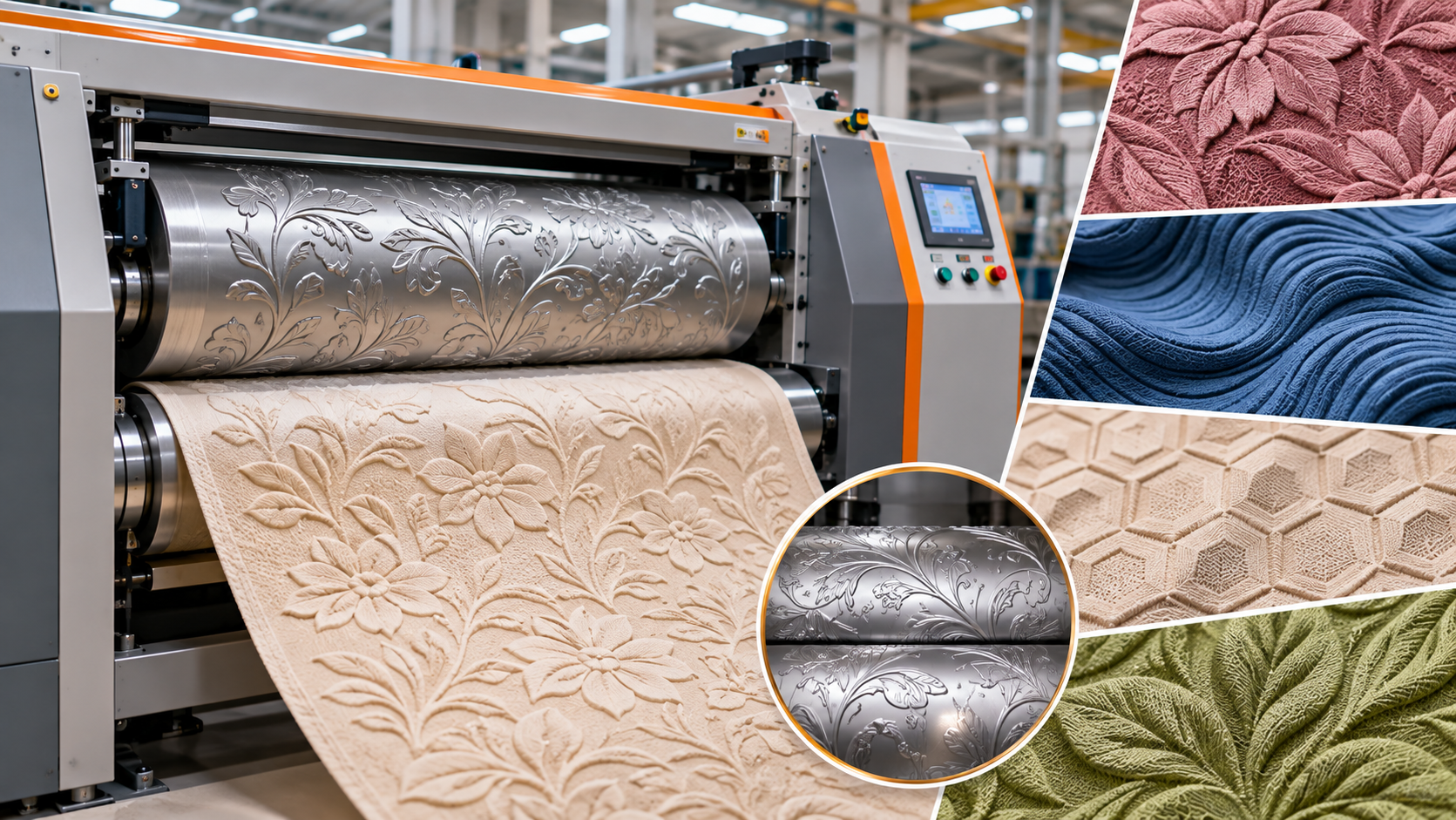
Is your embossing machine producing uneven fabric patterns? Learn how hydraulic issues, roller alignment, faulty pressure controls, and incorrect settings affect embossing pressure, along with practical troubleshooting and maintenance tips.
Consistent pressure is one of the most important requirements in textile embossing. It helps transfer patterns evenly onto fabric and maintain a uniform surface finish throughout production. When an embossing machine fails to maintain consistent pressure, the results may include faded patterns, uneven impressions, fabric marks, and differences in texture across the material.
This problem can occur in both small and large production setups. Sometimes the reason is as simple as incorrect pressure adjustment or uneven fabric thickness. In other cases, worn rollers, hydraulic or pneumatic system problems, mechanical misalignment, or faulty pressure controls may be responsible.
Understanding how the pressure system works and identifying the source of the problem can help operators reduce fabric wastage and maintain better finishing quality.
How Does the Pressure System Work in an Embossing Machine?
The pressure system controls the force applied between the embossing rollers or plates during fabric processing.
When fabric passes through the embossing section, the machine applies controlled pressure to transfer the selected pattern onto the material. Depending on the machine design, pressure may be generated and adjusted through mechanical, hydraulic, pneumatic, or electrically controlled arrangements.
The pressure must remain suitable for the fabric type, thickness, and embossing pattern. If it changes during operation, the pattern may become inconsistent.
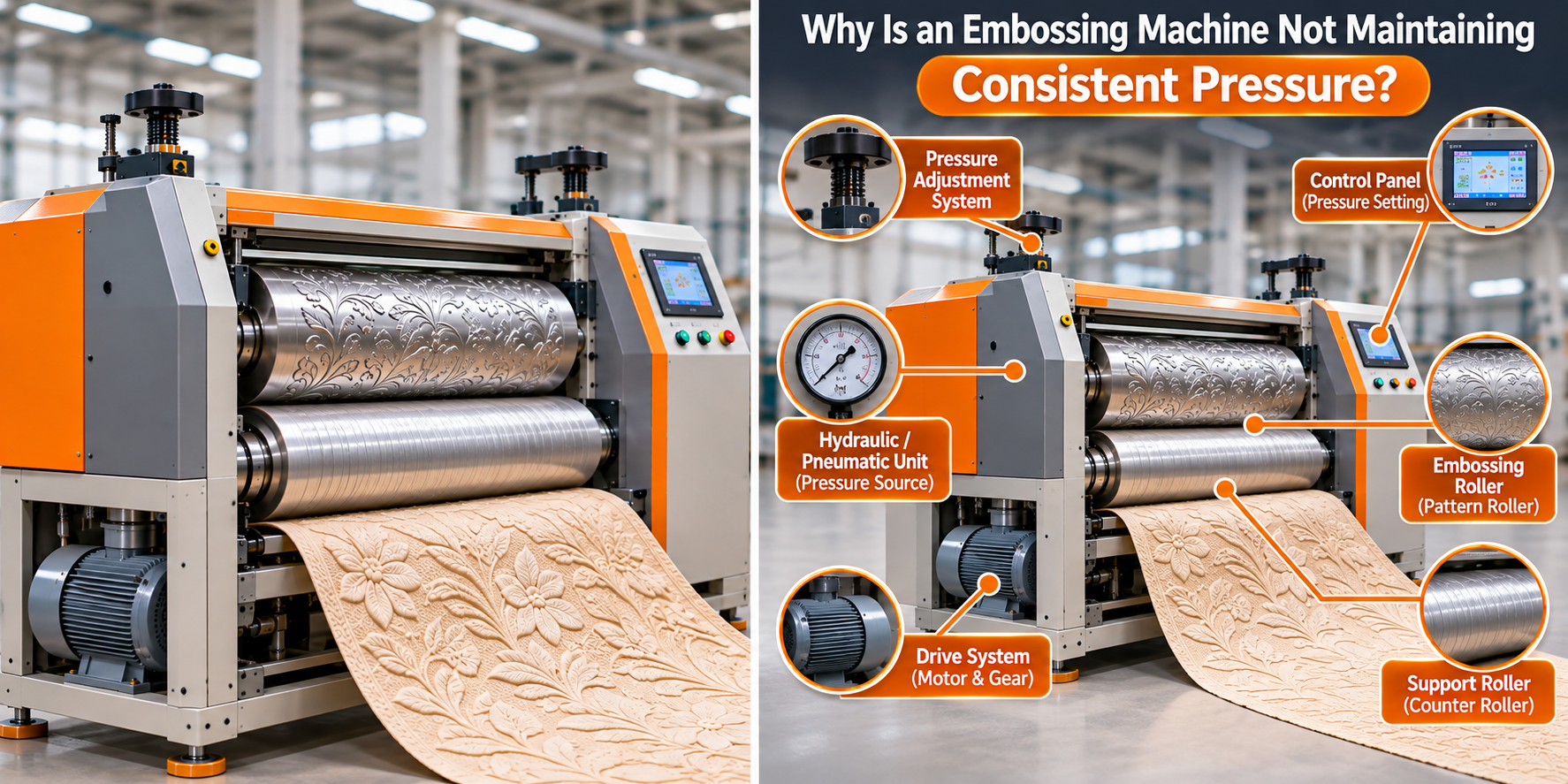
Important Embossing Machine Parts Responsible for Pressure Control
Several components work together to generate, adjust, and maintain pressure during embossing.
1. Embossing Rollers
Embossing rollers come into direct contact with the fabric and transfer the selected pattern onto its surface.
How they affect pressure:
- Maintain contact between the embossing surfaces.
- Transfer pressure across the fabric width.
- Help create consistent pattern impressions.
- Support continuous fabric processing.
Worn, damaged, or incorrectly aligned rollers can create uneven pressure across the fabric.
2. Pressure Adjustment Mechanism
The pressure adjustment mechanism allows the operator to increase or decrease the force applied during embossing.
Depending on the machine, this may involve mechanical adjustments, hydraulic controls, pneumatic components, or powered adjustment systems.
How it affects pressure: Incorrect adjustment, worn components, or loose connections can cause pressure variations during production.
3. Hydraulic Cylinder
In machines that use hydraulic pressure, the hydraulic cylinder converts fluid pressure into mechanical force to move or press the working components.
How it affects pressure: Internal leakage, damaged seals, or cylinder wear can reduce the force applied to the embossing rollers.
4. Hydraulic Pump
The hydraulic pump supplies pressurised oil to the hydraulic circuit.
How it affects pressure: Low oil levels, pump wear, contamination, or poor pump performance can cause unstable hydraulic pressure.
5. Pressure Control Valve
The pressure control valve regulates the pressure within the hydraulic circuit.
How it affects pressure: A damaged, contaminated, or incorrectly adjusted valve may prevent the machine from maintaining the required pressure.
6. Pressure Gauge or Sensor
A pressure gauge or electronic sensor helps operators monitor the pressure applied by the machine.
How it affects pressure: Incorrect readings, sensor faults, or calibration problems can lead to unsuitable pressure settings.
7. Bearings and Roller Alignment System
Bearings support roller rotation, while the alignment system helps maintain the correct position of the rollers.
How they affect pressure: Worn bearings or misaligned rollers can create uneven contact, resulting in inconsistent pressure across the fabric.
8. Control Panel
The control panel allows operators to manage pressure-related settings and monitor machine operation, depending on the machine's configuration.
How it affects pressure: Incorrect settings, control faults, or sensor communication problems can affect the pressure adjustment system.
Common Reasons Why an Embossing Machine Is Not Maintaining Consistent Pressure
1. Incorrect Pressure Settings
One of the simplest reasons for inconsistent embossing is incorrect pressure adjustment.
Different fabrics require different pressure levels. A setting suitable for thick upholstery material may not be appropriate for thin synthetic fabric.
Possible signs:
- Some areas have clear patterns while others appear faint.
- The fabric surface looks uneven.
- Pattern depth changes between production batches.
Solutions:
- Check the pressure setting before starting production.
- Adjust pressure according to fabric thickness and composition.
- Follow the manufacturer's recommended operating range.
- Test the setting on a sample fabric before processing a full roll.
Avoid increasing pressure unnecessarily, as excessive force can damage the fabric or embossing rollers.
2. Hydraulic Oil Leakage
In hydraulic embossing machines, oil leakage can reduce the pressure available to operate the cylinder.
Leakage may occur through damaged seals, loose pipe connections, worn hoses, or cylinder components.
Possible signs:
- Pressure drops during operation.
- Visible oil leakage near hydraulic connections.
- Rollers fail to maintain their required pressing position.
- The machine takes longer to reach the selected pressure.
Solutions:
- Inspect accessible hydraulic connections for leakage.
- Check hoses and seals for visible damage.
- Maintain the recommended hydraulic oil level.
- Replace damaged seals or hoses.
- Arrange a professional inspection if the pressure continues to fluctuate.
3. Hydraulic Pump Not Working Properly
The hydraulic pump is responsible for supplying oil at the required pressure. If its performance becomes weak, the machine may struggle to maintain consistent force.
Common causes include pump wear, oil contamination, low oil levels, and restricted oil flow.
Possible signs:
- Slow pressure build-up.
- Unstable pressure readings.
- Unusual pump noise.
- Reduced pressing performance.
Solutions:
- Check the hydraulic oil level.
- Inspect the oil for contamination.
- Follow the recommended oil replacement schedule.
- Check filters and oil flow.
- Arrange pump inspection if the problem continues.
4. Faulty Pressure Control Valve
The pressure control valve helps regulate hydraulic pressure. If the valve becomes blocked, damaged, or incorrectly adjusted, the machine may experience pressure fluctuations.
Possible signs:
- Pressure changes unexpectedly.
- The machine cannot maintain the selected pressure.
- Pressure readings become inconsistent.
- Adjustments do not produce the expected result.
Solutions:
- Check the valve for contamination or visible damage.
- Inspect the valve according to the manufacturer's maintenance instructions.
- Verify the pressure adjustment settings.
- Replace faulty components when required.
Valve inspection and repair should be carried out by a qualified technician.
5. Uneven Roller Alignment
Even if the machine generates sufficient pressure, incorrect roller alignment can result in uneven pressure distribution.
This may happen after maintenance, component replacement, mechanical wear, or accidental movement of the roller assembly.
Possible signs:
- One side of the fabric has a deeper impression.
- The centre and edges show different pattern clarity.
- Embossing quality changes across the fabric width.
Solutions:
- Check roller positioning.
- Inspect alignment and mounting arrangements.
- Verify that bearings are in good condition.
- Arrange alignment correction according to the machine specifications.
6. Worn Bearings and Mechanical Components
Bearings support the smooth movement and positioning of rotating components. When they become worn, loose, or damaged, roller movement may become uneven.
Other worn mechanical parts can also affect the stability of the pressure arrangement.
Possible signs:
- Unusual noise during operation.
- Roller vibration.
- Uneven fabric impressions.
- Increased friction or resistance.
Solutions:
- Inspect bearings for wear.
- Check mounting points and mechanical connections.
- Lubricate components according to the manufacturer's instructions.
- Replace damaged bearings and worn parts.
7. Incorrect Fabric Thickness or Uneven Fabric Feeding
Fabric thickness has a direct effect on the embossing pressure required. If the material thickness changes across the roll or fabric feeding becomes uneven, the pressure applied to the surface may also vary.
Possible signs:
- Pattern depth changes at different points.
- Fabric wrinkles or shifts during processing.
- Pressure variations occur only with certain materials.
Solutions:
- Check fabric thickness before processing.
- Maintain proper fabric alignment.
- Inspect the feeding rollers.
- Adjust pressure according to material specifications.
- Maintain consistent fabric tension.
8. Faulty Pressure Sensor or Gauge
The pressure sensor or gauge provides information about the pressure level. If its readings are inaccurate, operators may select incorrect settings without realising it.
Possible signs:
- Pressure readings fluctuate unexpectedly.
- The displayed value does not match machine performance.
- Pressure adjustment becomes difficult.
- The machine behaves differently despite unchanged settings.
Solutions:
- Check sensor connections.
- Verify gauge accuracy.
- Arrange calibration where required.
- Replace damaged sensors or gauges.
- Inspect the control system if readings remain incorrect.
9. Electrical or Control System Problems
Machines with electrically controlled pressure systems depend on sensors, wiring, control boards, and actuators to manage pressure adjustments.
Loose connections, damaged wiring, faulty control components, or incorrect settings can interrupt this process.
Possible signs:
- Pressure settings change unexpectedly.
- The machine does not respond correctly to control panel commands.
- Pressure readings disappear or show errors.
- The pressure adjustment mechanism operates intermittently.
Solutions:
- Check displayed error messages.
- Inspect accessible cable connections.
- Verify machine settings.
Arrange electrical and control system inspection through a qualified technician.
Troubleshooting Table: Inconsistent Embossing Machine Pressure
Problem observed | Possible cause | Recommended action |
| Pressure drops during operation | Hydraulic leakage or pump issue | Inspect oil level, hoses, seals, and pump |
| Uneven pattern across fabric width | Roller misalignment | Check roller alignment and bearings |
| Pressure fluctuates unexpectedly | Faulty control valve or sensor | Inspect pressure control components |
| Machine takes longer to build pressure | Pump wear or restricted oil flow | Check pump and filters |
| One side has deeper impressions | Uneven roller contact | Verify roller positioning |
| Pressure reading is incorrect | Faulty gauge or sensor | Check and calibrate the measuring device |
| Pressure changes with different fabrics | Fabric thickness variation | Adjust settings according to the material |
How to Maintain Consistent Pressure During Textile Embossing
Preventive maintenance helps reduce unexpected pressure changes and supports consistent fabric finishing.
Daily Maintenance
- Check the pressure reading before production.
- Inspect accessible hydraulic connections for visible leakage.
- Check the embossing rollers for damage.
- Observe the machine for unusual noise or vibration.
- Confirm that fabric feeding is smooth and properly aligned.
Weekly Maintenance
- Inspect hydraulic hoses and connections.
- Check the condition of accessible pressure adjustment components.
- Examine rollers and bearings.
- Check the pressure gauge or sensor for unusual readings.
- Clean dust and fabric residue from machine areas.
Periodic Maintenance
- Check hydraulic oil condition and replace it according to the recommended schedule.
- Inspect the pump, cylinder, and pressure control valve.
- Verify roller alignment.
- Check sensor accuracy and calibration.
- Inspect the motor, drive system, and electrical controls.
- Replace worn components according to the manufacturer's recommendations.
Never attempt to repair pressurised hydraulic lines or work near moving rollers while the machine is operating. Follow the manufacturer's safety procedures and use qualified technicians for pressure-system repairs.
What Should You Check Before Buying an Industrial Embossing Machine?
If you are planning to purchase new embossing equipment, pressure control should be one of the main points in your evaluation.
A suitable industrial embossing machine should match the fabric type, working width, required pattern, and production volume.
Before purchasing, consider the following:
1. Pressure adjustment range: Check whether the machine can provide suitable pressure for the fabrics you plan to process.
2. Pressure control system: Understand whether the machine uses mechanical, hydraulic, pneumatic, or electronic pressure adjustment.
3. Roller quality: Check the roller material, surface finish, alignment, and availability of different patterns.
4. Working width: Select a machine according to the maximum fabric width used in your production process.
5. Temperature control: If heat-assisted embossing is required, check the heating arrangement and temperature control accuracy.
6. Production speed: Compare the operating speed with your production targets.
7. Maintenance requirements: Understand the inspection schedule, spare parts availability, and servicing needs.
8. Fabric testing: Request a trial using your actual fabric to evaluate pressure consistency and final pattern quality.
Explore Textile Machinery Options with the Right Technical Understanding
Consistent pressure is essential for achieving uniform fabric embossing. Problems can arise from incorrect settings, hydraulic faults, worn mechanical components, roller misalignment, or inaccurate pressure readings.
Regular inspection and proper machine operation can help identify these issues early and reduce unnecessary fabric wastage.
Ramana Machines is a supplier, distributor, and trader of knitting and textile machinery. As a textile trading company in India, we help businesses explore machinery options according to their production requirements and operational needs.
Visit www.ramanainternational.com or contact our team to discuss your textile machinery requirements.